



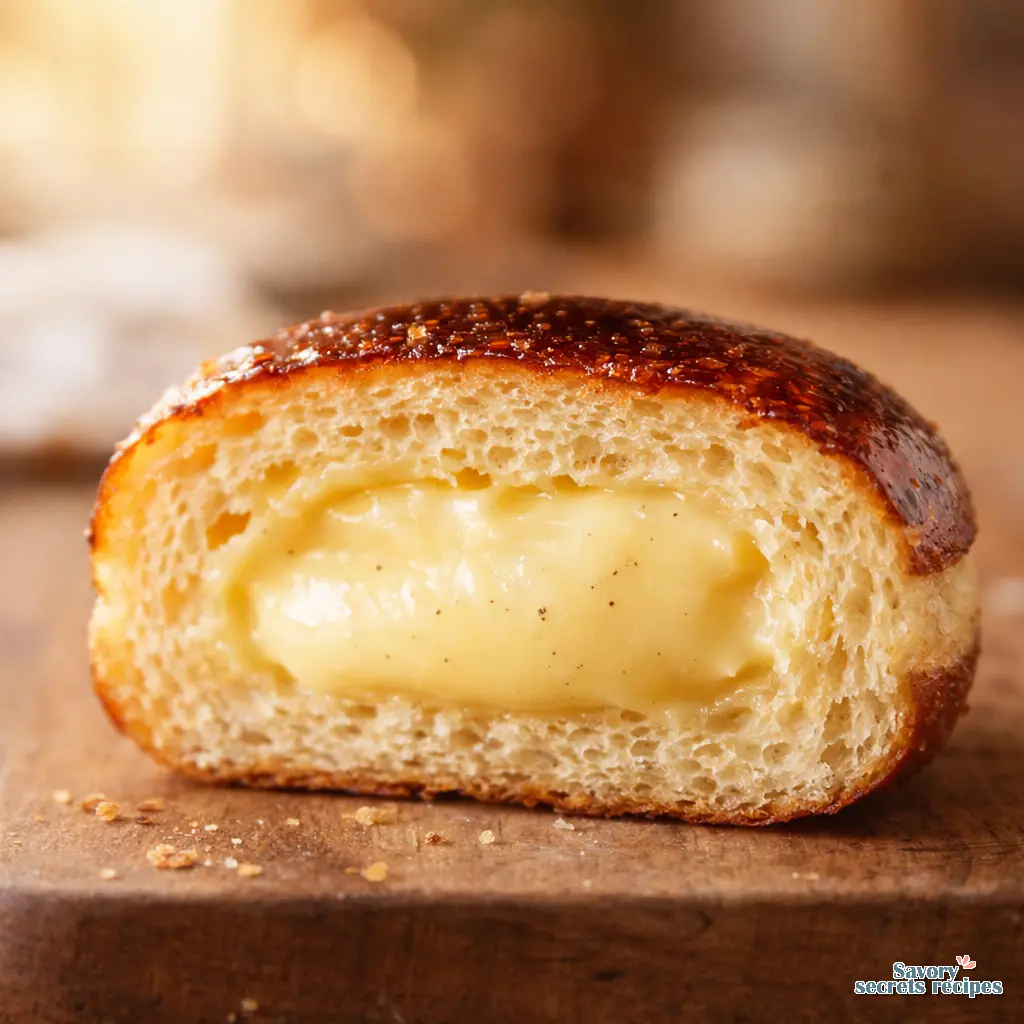
Gourmet Vanilla Custard Filled Creme Brulee Donuts
Ingredients
Method
- Combine warm milk and yeast in a small bowl and let the mixture sit for 5 to 10 minutes until foamy.
- Mix the flour, salt, and sugar together in a large bowl.
- Add the egg, softened butter, and yeast mixture to the dry ingredients.
- Stir the mixture until a soft dough forms, then knead it until it becomes smooth and elastic.
- Place the dough in a greased bowl, cover it, and allow it to rise for about 1 hour or until doubled in size.
- Punch down the dough and roll it out on a lightly floured surface to a thickness of approximately 1/2 inch.
- Cut out rounds from the dough using a 3 1/2-inch cookie cutter.
- Arrange the rounds on parchment paper, cover them, and let them rise for an additional 30 to 40 minutes.
- Heat oil to 350°F and fry the donuts in batches for 2 minutes per side until golden brown.
- Drain the donuts on paper towels and allow them to cool completely.
- Beat the heavy cream, instant pudding, and milk until the mixture is thick and creamy to prepare the filling.
- Transfer the filling to a piping bag and fill each donut through the side.
- Heat sugar and water in a saucepan over medium-high heat for 7 to 9 minutes without stirring until it reaches a golden amber color.
- Carefully dip the top of each filled donut into the hot caramel.
- Allow the caramel to harden to achieve a signature brûlée crunch, then serve.
Nutrition
Notes
The Pursuit of the Perfect Shatter
You know that sound. That sharp, distinct crack of a spoon breaking through a hard caramel shell. I once tried to capture that exact sound for a video shoot featuring creme brulee donuts. We set up the macro lens, got the boom mic perfectly positioned, and I tapped the sugar crust. The sound was incredible, but we completely blew out the camera sensor because the studio lights reflected right off that glossy caramelization. We had to reshoot the entire sequence. Figured out how to light for texture that day, but more importantly, I learned that timing is everything with these pastries.
My uncle Marc ran a small French bistro in Rittenhouse back in the nineties. I remember him letting me stand on a milk crate at his prep station, teaching me how to brunoise carrots. He would actually measure my cuts with a ruler. If they weren’t within a millimeter, I’d start over. Seemed harsh at the time, but now I get it. Consistency matters. That same consistency is what turns a regular piece of fried dough into proper gourmet creme brulee donuts. You need that shatteringly crisp exterior giving way to a rich, silky vanilla bean center. Let me show you what I mean.
If you’ve ever felt intimidated by making a custard filled pastry from scratch, I completely understand. I’m still figuring out the balance between showing ideal technique on camera and acknowledging that most people are cooking in imperfect conditions. But this recipe breaks down the science into manageable steps. Grab your ingredients on your next Trader Joe’s run, and let’s build something amazing.
Mastering the Brioche Dough: Yeast Troubleshooting Guide
The foundation of all great creme brulee donuts is a solid, enriched brioche dough. Here’s the thing about that: yeast is a living organism, and it is notoriously picky about temperature. I’ve ruined entire batches by rushing this step.
Always check your yeast expiration dates and test viability with warm water and sugar before starting. You’ll know it’s ready when it gets foamy and smells slightly sour, usually after five to ten minutes. Ensure your milk is between 100 and 110F. Too hot will kill the yeast, and too cold won’t activate it. I use my instant-read thermometer for this. I think most home cooks would benefit more from a good instant-read thermometer than from any other single tool in the kitchen.
During those cool spring mornings in LA, your kitchen might be a bit drafty. Find a warm spot for the dough to rise. You want it to double in size. If you underproof the dough, you end up with dense donuts. If you overproof it, the dough structure weakens, leading to incredibly oily donuts because they absorb too much fat during frying. Trust the process on this one and watch the dough, not the clock.
Frying: Oil Temperature and Thermometer Tips
Frying can be messy, so protect your surfaces with towels and wear an apron to handle oil splatter. This isn’t just about keeping your kitchen clean; it’s about safety. The key step here is maintaining your oil temperature at exactly 350F. You absolutely must use a candy or frying thermometer to maintain consistent oil temperature.
If you don’t have a thermometer handy, test oil readiness with a wooden spoon or skewer. Dip the handle into the oil; steady bubbles should form around it. However, I’d probably lean toward just buying the thermometer. It takes the guesswork out entirely.
Only fry three or four donuts at a time to avoid overcrowding and oil temp drops. If the temperature plummets, the dough just drinks the oil. Use a slotted spoon or skimmer to gently flip and remove the donuts. Allow the donuts to drain on paper towels after frying so the exterior stays relatively dry. This is crucial for the sugar topping later.
Internal Donut Temperature Guide
How do you know the inside is cooked? Color is a liar. I’ve pulled deeply golden donuts from the oil only to find raw, gummy dough in the center. Makes sense to me now, but it was frustrating back then.
Instead of guessing, use that instant-read thermometer again. Probe the side of a donut right into the center. You are looking for an internal temperature of 190F. At this stage, the starches have fully gelatinized, and the crumb will be light and fluffy. This is exactly what you want before piping in your creme patisserie.
Perfecting the Vanilla Creme Patisserie
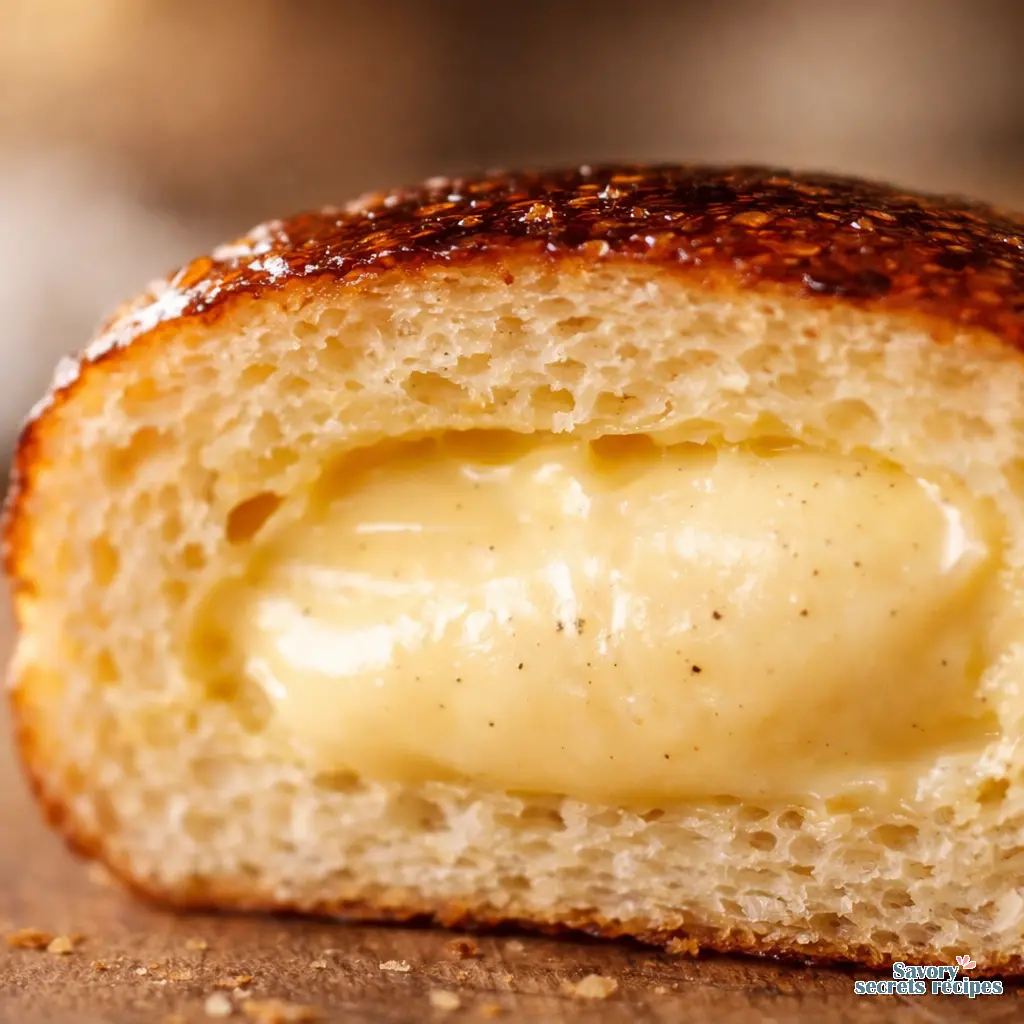
If we are making the best vanilla custard for donut filling, we need to talk about ingredients. I prefer European-style butter for anything where you’ll actually taste it. The higher fat content makes a real difference in pastry creams. You’ll need egg yolks, cornstarch, heavy cream, and real vanilla. I’ve been teaching my daughter to smell herbs and spices, and vanilla bean is her absolute favorite. We scrape the seeds together, and it smells incredible.
The trickiest part is tempering the eggs. Pour the hot milk mixture into your egg yolks very slowly while whisking constantly. If you scramble the eggs, you’ll have a bad time. But let’s say things go slightly wrong. Blend grainy or lumpy pastry cream in a blender for 30 seconds to restore smoothness. Not a huge deal, but worth noting that you can save it.
You want this custard thick. It needs to hold up inside the dough without weeping. Once it cools, transfer it to a piping bag. Poking a hole in the side of the donut and filling it until it feels heavy in your hand is incredibly satisfying. This is a brilliant creme brulee donut recipe alcohol free option, relying entirely on the pure, aromatic power of vanilla bean rather than extracts or liquors.
The Science of the Brûlée Shell
Now we’re talking. This is the good stuff. The defining feature of creme brulee donuts is the hard caramel shell. You have two options here: the wet caramel dipping method or using a kitchen torch with granulated sugar.
If you’re using a torch, dip the top of the filled donut in granulated sugar. How to torch sugar on a donut without burning it or melting the custard inside? Hold the flame about two inches away and keep it moving constantly. You want the sugar to bubble and melt into an amber pool. If you hold it still, it turns black and bitter instantly.
I actually prefer the wet caramel dipping method for a thicker, glassier shell. You boil sugar and water until it reaches the hard crack stage. Work slowly with caramel as it browns quickly even off the heat. Take the caramel pot off the heat occasionally to swirl and prevent burning. Smell the caramel; it should be deep and caramelized, not bitter or burnt.
Caramel Dipping Safety and Technique
I need to be very clear about this part. Liquid sugar is essentially culinary napalm. Wear a glove to protect hands from extremely hot caramel splatters. I’ve seen nasty burns in professional kitchens from careless caramel handling.
Dip the top of the donut into the hot caramel quickly and carefully, then let the excess drip off. Return caramel to heat and swirl if it begins to harden during dipping. Place the dipped donuts on a wire rack. Do not cover them while warm, or the trapped humidity will cause the caramel to go soggy. You want that sugar to harden into a perfect, shatterable sheet.
Common Mistakes & Fixes
Mistake: Killing yeast with water or milk that is too hot.
Solution: Always use a thermometer. Keep liquids strictly between 100-110F.
Mistake: Overcrowding the frying pot.
Solution: This drops the oil temperature, leading to greasy dough. Fry in small batches of three or four.
Mistake: Stirring sugar while it dissolves in the wet caramel method.
Solution: Stirring causes crystallization. Just gently swirl the pan instead.
Mistake: Covering donuts while warm.
Solution: The steam will melt your hard work. Leave them uncovered at room temperature to maintain the crunch.
Sugar-Pot Cleaning Guide
After dipping your creme brulee donuts, your pot is going to be coated in rock-hard sugar. Don’t try to scrub it; you’ll just ruin your sponge and your mood. Here’s a trick I learned from our lead test cook. Fill the sticky pot with water, put it back on the stove, and bring it to a rolling boil. The heat and water will dissolve the hard caramel entirely in about ten minutes. Pour it down the sink, and the pot is perfectly clean. That’s a solid approach that saves so much time.
Make-Ahead Schedule for 2-Day Preparation
I like recipes that scale easily and don’t require you to spend twelve straight hours in the kitchen. Breaking this down over two days makes it highly manageable, especially if you’re hosting a weekend brunch.
Day One: Make your vanilla creme patisserie. It needs time to chill and set up properly anyway. Store it in the fridge with plastic wrap pressed directly against the surface to prevent a skin from forming. Next, mix and knead your brioche dough. Let it do its first rise in the fridge overnight. Cold dough is actually much easier to roll and cut.
Day Two: Roll, cut, and proof the dough rounds. Fry them up, let them cool slightly, and pipe in your chilled custard. Finally, make your caramel or break out the kitchen torch right before your guests arrive.
Storage and Fridge Requirements
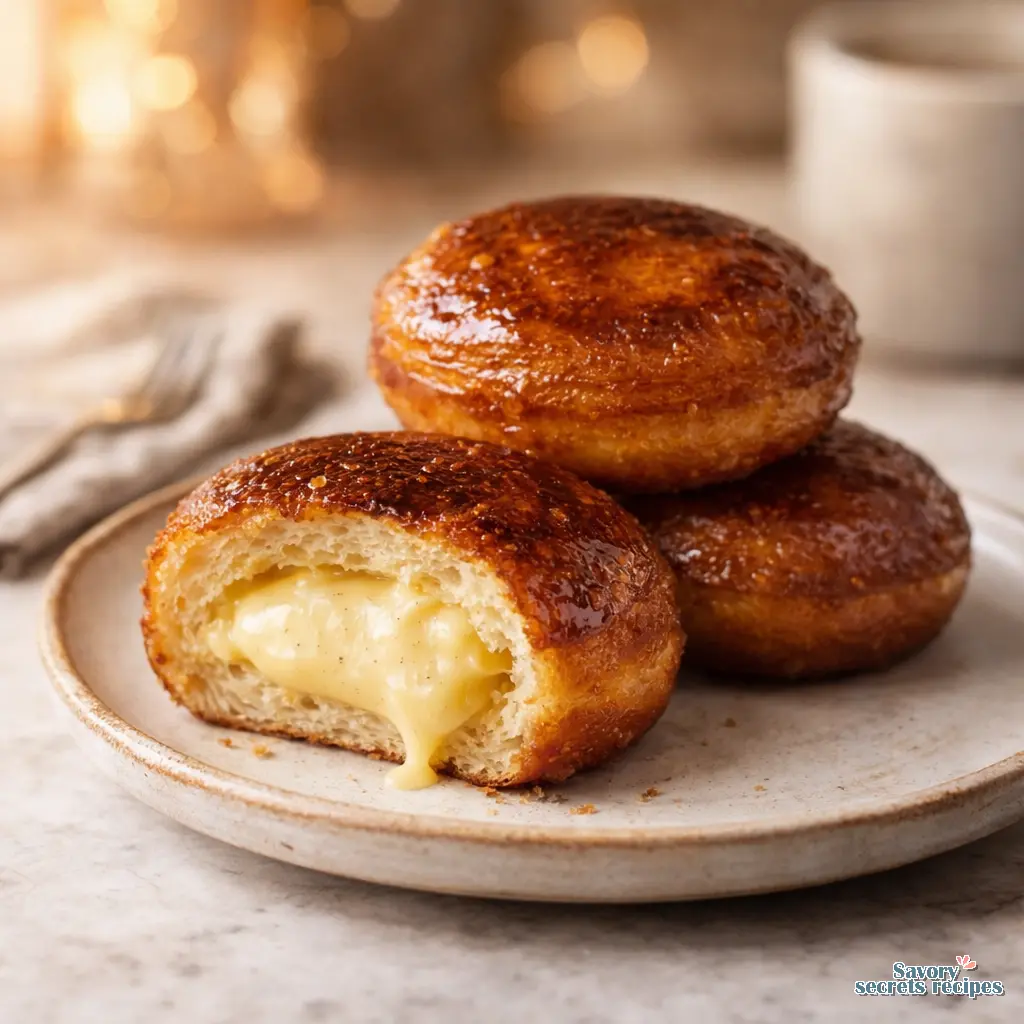
Here’s the unfortunate truth about creme brulee donuts: they are highly perishable. Because of the dairy-rich custard filling, you must store leftovers in an airtight container in the refrigerator. However, the fridge is a humid environment, and humidity is the enemy of hard caramel.
If you put a torched donut in the fridge, the sugar shell will melt into a sticky syrup within a few hours. It will still taste fantastic, serving cold from the fridge for a refreshing custard experience, but you lose that signature crunch. For the absolute best texture, keep them uncovered at room temperature for a few hours to maintain the crunch, and eat them the same day they are made. If you have un-fried dough rounds, you can freeze them after cutting, then thaw and fry later.
Frequently Asked Questions
The Final Plate
There is something genuinely satisfying about pulling off a complex pastry project at home. When you finally bite into these creme brulee donuts, and you get that loud crack followed by the cold, silky vanilla custard, it justifies the entire enterprise. It reminds me of sitting at the zinc bar at my uncle’s place after service, eating whatever the kitchen had made for staff meal. Simple, perfect, and totally worth the effort.
If you’re hosting a brunch or just want to challenge yourself in the kitchen this weekend, give this a try. Take your time with the yeast, respect the oil temperature, and please be careful with the hot sugar. For more inspiration, check out my Pinterest boards where I save all my favorite weekend baking projects.
Reference: Original Source
What is tangzhong and should I use it for creme brulee donuts?
Tangzhong is a Japanese technique of cooking a small amount of flour and water into a paste before adding it to the dough. It pre-gelatinizes the starches, making the brioche dough incredibly soft and helping it stay fresh longer. I highly recommend it for this recipe.
Why did my creme brulee donuts turn out dense?
Dense donuts usually happen for three reasons: your yeast was expired, the milk was too hot and killed the yeast, or you severely underproofed the dough. Always check your yeast viability first and ensure your dough doubles in size before frying.
Why are my donuts so oily?
Oily dough is almost always a temperature issue. If your frying oil drops below 350F, the dough absorbs the fat instead of cooking quickly. It can also happen if you overproof the dough, which weakens its structure and allows oil to seep in.
Why is my caramel sticky instead of crispy?
If your caramel topping is sticky, you likely didn’t cook the sugar syrup to the hard-crack stage (300F). Alternatively, if you covered the warm donuts, the trapped steam melted the sugar. Always leave them uncovered at room temperature.
Can these custard filled donuts be made without a stand mixer?
You can absolutely make this without a mixer, but be prepared for a workout. Brioche dough is very wet and sticky initially. You’ll need to knead it by hand for about 15-20 minutes until it becomes smooth and elastic. Use the slap-and-fold technique.
How do you store homemade creme brulee donuts?
Because of the dairy in the vanilla creme patisserie, they must be stored in the refrigerator in an airtight container. Be aware that the cold, humid air will soften the crunchy sugar shell. They are truly best eaten within a few hours of making them.
Can I omit the egg in the brioche dough?
I wouldn’t recommend it. Eggs provide crucial fat, protein, and emulsifiers that give brioche its signature rich flavor and tender, fluffy structure. Without the egg, the dough will lack stability and won’t hold up well to the heavy custard filling.